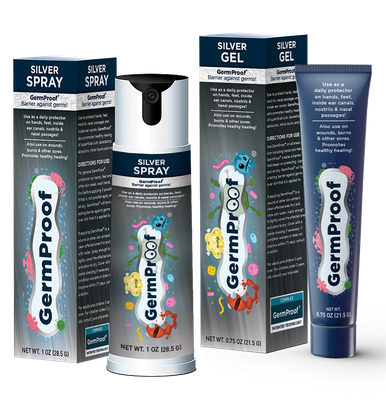
GermProof® protects against MRSA
 

You should GermProof® your feet and hands before using high traffic gyms and other highly frequented public areas, here is why!

Gymnasts tend to practice barefoot, especially on sweaty, high-traffic mats and flooring. They also tend to use bars and other equipment that are constantly exposed to countless more sweaty hands and feet. These sweaty surfaces are a breeding ground for dangerous bacteria such as athletes foot, as well as other infection-causing bacteria, including the potentially deadly MRSA!

What about fitness gyms, and all the sweaty dumbbells and other high traffic equipment, just swarming with potentially dangerous bacteria?

  1. The potentially deadly MRSA infection, which was once seen primarily in hospitalized patients, has now been linked to common foot conditions. GermProof® not only provides a GermProof® barrier of protection against MRSA infection and other potentially harmful bacteria germs, it also fights MRSA and heals MRSA-related infections.

Source:

American College of Foot and Ankle Surgeons

Summary:

More Americans are developing drug-resistant staph infections, known as MRSA from common, relatively minor foot problems such as cuts, cracks in the skin, athlete's foot, and ingrown toenails. Foot and ankle surgeons are noting an increase in community-associated MRSA or methicillin-resistant Staphylococcus aureus.

FULL STORY

More Americans are developing drug-resistant staph infections, known as MRSA, from ordinary, relatively minor foot problems such as cuts, cracks in the skin, athlete's foot and ingrown toenails, according to the American College of Foot and Ankle Surgeons (ACFAS). Foot and ankle surgeons are noting an increase in community-associated MRSA or methicillin-resistant Staphylococcus aureus.

MRSA Linked to Athlete's Foot, Ingrown Toenails

"If you have a cut or a scrape that gets infected and it's not healing in a timely fashion, don't hesitate to get it checked out," said Karl Collins, DPM, FACFAS, a foot and ankle surgeon in St. Louis. Dr. Collins said he's diagnosed community-associated MRSA infections in patients with athlete's foot, and even a six-year-old who stubbed his toe.

Brandi Johnson, DPM, AACFAS, estimates treating 20 patients for community-associated MRSA last year. The Brandon, Florida foot and ankle surgeon says half of those patients had infected ingrown toenails. Puncture wounds, pedicures and cuts from glass and seashells caused the rest of the infections.

One of Johnson's patients was a teenage boy. He waited months before seeing a doctor for an infected ingrown toenail. After the boy's primary care doctor referred him to Johnson, she ran several tests. Results showed a community-associated MRSA infection. Even worse, it had spread to the bone in the teen's big toe. He recovered after six weeks of intravenous antibiotics.

"I've had several high schoolers come in with ingrown toenails recently," Dr. Johnson said. "Their pediatricians started them on antibiotics and sent them to my office. Lab results showed they all had MRSA."

Preventing Infection

Staph bacteria such as MRSA are common. One in three people carries them. The bacteria live on the skin and in the nose and are spread through skin contact. Even minor tears in the skin's surface open the door to bacteria and infection. Skin conditions such as athlete's foot, calluses, corns, eczema, and psoriasis can create breaks in the skin. Walking barefoot increases the risk of cuts and puncture wounds. Foot and ankle surgeons say simple steps can prevent community-associated MRSA infections:

  • Wash and bandage cuts.
  • See a doctor within 24 hours for any puncture wound.
  • Never perform "bathroom surgeries" to cut or dig out an ingrown toenail.
  • Keep feet clean and dry to prevent fungal infections such as athlete's foot.

MRSA Becomes a Community Problem

According to a study by the Centers for Disease Control and Prevention, 14 percent of MRSA cases are community-associated, and 85 percent are healthcare-associated.

Healthcare-associated MRSA has existed for decades in settings such as hospitals and nursing homes. But within the past decade, community-associated MRSA has emerged as a threat, as outbreaks occur in schools, sports teams, prisons, and other places in the community with populations that are generally healthy.

Story Source:

Materials provided by the American College of Foot and Ankle Surgeons. Note: Content may be edited for style and length.

Cite This Page:

American College of Foot and Ankle Surgeons. "MRSA: Potentially Deadly Infection, Once Seen Primarily In Hospitalized Patients, Now Linked To Common Foot Conditions." ScienceDaily. ScienceDaily, 25 May, 2009. <www.sciencedaily.com/releases/2009/05/090520064137.htm>.

You should GermProof® your feet and hands before using high traffic gyms and other highly frequented public areas, here is why!

Gymnasts tend to practice barefoot, especially on sweaty, high-traffic mats and flooring. They also tend to use bars and other equipment that are constantly exposed to countless more sweaty hands and feet. These sweaty surfaces are a breeding ground for dangerous bacteria such as athletes foot, as well as other infection-causing bacteria, including the potentially deadly MRSA!

What about fitness gyms, and all the sweaty dumbbells and other high traffic equipment, just swarming with potentially dangerous bacteria?

  1. The potentially deadly MRSA infection, which was once seen primarily in hospitalized patients, has now been linked to common foot conditions. GermProof® not only provides a GermProof® barrier of protection against MRSA infection and other potentially harmful bacteria germs, it also fights MRSA and heals MRSA-related infections.

Source:

American College of Foot and Ankle Surgeons

Summary:

More Americans are developing drug-resistant staph infections, known as MRSA from common, relatively minor foot problems such as cuts, cracks in the skin, athlete's foot, and ingrown toenails. Foot and ankle surgeons are noting an increase in community-associated MRSA or methicillin-resistant Staphylococcus aureus.

FULL STORY

More Americans are developing drug-resistant staph infections, known as MRSA, from ordinary, relatively minor foot problems such as cuts, cracks in the skin, athlete's foot and ingrown toenails, according to the American College of Foot and Ankle Surgeons (ACFAS). Foot and ankle surgeons are noting an increase in community-associated MRSA or methicillin-resistant Staphylococcus aureus.

MRSA Linked to Athlete's Foot, Ingrown Toenails

"If you have a cut or a scrape that gets infected and it's not healing in a timely fashion, don't hesitate to get it checked out," said Karl Collins, DPM, FACFAS, a foot and ankle surgeon in St. Louis. Dr. Collins said he's diagnosed community-associated MRSA infections in patients with athlete's foot, and even a six-year-old who stubbed his toe.

Brandi Johnson, DPM, AACFAS, estimates treating 20 patients for community-associated MRSA last year. The Brandon, Florida foot and ankle surgeon says half of those patients had infected ingrown toenails. Puncture wounds, pedicures and cuts from glass and seashells caused the rest of the infections.

One of Johnson's patients was a teenage boy. He waited months before seeing a doctor for an infected ingrown toenail. After the boy's primary care doctor referred him to Johnson, she ran several tests. Results showed a community-associated MRSA infection. Even worse, it had spread to the bone in the teen's big toe. He recovered after six weeks of intravenous antibiotics.

"I've had several high schoolers come in with ingrown toenails recently," Dr. Johnson said. "Their pediatricians started them on antibiotics and sent them to my office. Lab results showed they all had MRSA."

Preventing Infection

Staph bacteria such as MRSA are common. One in three people carries them. The bacteria live on the skin and in the nose and are spread through skin contact. Even minor tears in the skin's surface open the door to bacteria and infection. Skin conditions such as athlete's foot, calluses, corns, eczema, and psoriasis can create breaks in the skin. Walking barefoot increases the risk of cuts and puncture wounds. Foot and ankle surgeons say simple steps can prevent community-associated MRSA infections:

  • Wash and bandage cuts.
  • See a doctor within 24 hours for any puncture wound.
  • Never perform "bathroom surgeries" to cut or dig out an ingrown toenail.
  • Keep feet clean and dry to prevent fungal infections such as athlete's foot.

MRSA Becomes a Community Problem

According to a study by the Centers for Disease Control and Prevention, 14 percent of MRSA cases are community-associated, and 85 percent are healthcare-associated.

Healthcare-associated MRSA has existed for decades in settings such as hospitals and nursing homes. But within the past decade, community-associated MRSA has emerged as a threat, as outbreaks occur in schools, sports teams, prisons, and other places in the community with populations that are generally healthy.

Story Source:

Materials provided by the American College of Foot and Ankle Surgeons. Note: Content may be edited for style and length.

Cite This Page:

American College of Foot and Ankle Surgeons. "MRSA: Potentially Deadly Infection, Once Seen Primarily In Hospitalized Patients, Now Linked To Common Foot Conditions." ScienceDaily. ScienceDaily, 25 May, 2009. <www.sciencedaily.com/releases/2009/05/090520064137.htm>.

You should GermProof® your feet and hands before using high traffic gyms and other highly frequented public areas, here is why!

Gymnasts tend to practice barefoot, especially on sweaty, high-traffic mats and flooring. They also tend to use bars and other equipment that are constantly exposed to countless more sweaty hands and feet. These sweaty surfaces are a breeding ground for dangerous bacteria such as athletes foot, as well as other infection-causing bacteria, including the potentially deadly MRSA!

What about fitness gyms, and all the sweaty dumbbells and other high traffic equipment, just swarming with potentially dangerous bacteria?

  1. The potentially deadly MRSA infection, which was once seen primarily in hospitalized patients, has now been linked to common foot conditions. GermProof® not only provides a GermProof® barrier of protection against MRSA infection and other potentially harmful bacteria germs, it also fights MRSA and heals MRSA-related infections.

Source:

American College of Foot and Ankle Surgeons

Summary:

More Americans are developing drug-resistant staph infections, known as MRSA from common, relatively minor foot problems such as cuts, cracks in the skin, athlete's foot, and ingrown toenails. Foot and ankle surgeons are noting an increase in community-associated MRSA or methicillin-resistant Staphylococcus aureus.


FULL STORY

More Americans are developing drug-resistant staph infections, known as MRSA, from ordinary, relatively minor foot problems such as cuts, cracks in the skin, athlete's foot and ingrown toenails, according to the American College of Foot and Ankle Surgeons (ACFAS). Foot and ankle surgeons are noting an increase in community-associated MRSA or methicillin-resistant Staphylococcus aureus.

MRSA Linked to Athlete's Foot, Ingrown Toenails

"If you have a cut or a scrape that gets infected and it's not healing in a timely fashion, don't hesitate to get it checked out," said Karl Collins, DPM, FACFAS, a foot and ankle surgeon in St. Louis. Dr. Collins said he's diagnosed community-associated MRSA infections in patients with athlete's foot, and even a six-year-old who stubbed his toe.

Brandi Johnson, DPM, AACFAS, estimates treating 20 patients for community-associated MRSA last year. The Brandon, Florida foot and ankle surgeon says half of those patients had infected ingrown toenails. Puncture wounds, pedicures and cuts from glass and seashells caused the rest of the infections.

One of Johnson's patients was a teenage boy. He waited months before seeing a doctor for an infected ingrown toenail. After the boy's primary care doctor referred him to Johnson, she ran several tests. Results showed a community-associated MRSA infection. Even worse, it had spread to the bone in the teen's big toe. He recovered after six weeks of intravenous antibiotics.

"I've had several high schoolers come in with ingrown toenails recently," Dr. Johnson said. "Their pediatricians started them on antibiotics and sent them to my office. Lab results showed they all had MRSA."

Preventing Infection

Staph bacteria such as MRSA are common. One in three people carries them. The bacteria live on the skin and in the nose and are spread through skin contact. Even minor tears in the skin's surface open the door to bacteria and infection. Skin conditions such as athlete's foot, calluses, corns, eczema, and psoriasis can create breaks in the skin. Walking barefoot increases the risk of cuts and puncture wounds. Foot and ankle surgeons say simple steps can prevent community-associated MRSA infections:

  • Wash and bandage cuts.
  • See a doctor within 24 hours for any puncture wound.
  • Never perform "bathroom surgeries" to cut or dig out an ingrown toenail.
  • Keep feet clean and dry to prevent fungal infections such as athlete's foot.

MRSA Becomes a Community Problem

According to a study by the Centers for Disease Control and Prevention, 14 percent of MRSA cases are community-associated, and 85 percent are healthcare-associated.

Healthcare-associated MRSA has existed for decades in settings such as hospitals and nursing homes. But within the past decade, community-associated MRSA has emerged as a threat, as outbreaks occur in schools, sports teams, prisons, and other places in the community with populations that are generally healthy.

Story Source:

Materials provided by the American College of Foot and Ankle Surgeons. Note: Content may be edited for style and length.

Cite This Page:

American College of Foot and Ankle Surgeons. "MRSA: Potentially Deadly Infection, Once Seen Primarily In Hospitalized Patients, Now Linked To Common Foot Conditions." ScienceDaily. ScienceDaily, 25 May, 2009. <www.sciencedaily.com/releases/2009/05/090520064137.htm>.

MRSA · what it is · what we tested

MRSA, plainly explained.

What MRSA actually is, why it turns up in gyms and schools and not only hospitals, and what an independent EPA GLP laboratory found when it tested our chelated silver against it in 2012.

Straight facts, no scare tactics, and no claims we can’t point at a report for.

Microbial cells illustration

What MRSA is

MRSA stands for methicillin-resistant Staphylococcus aureus. Staphylococcus aureus — “staph” — is an ordinary bacterium that lives on skin and in noses. Roughly one person in three carries it and is perfectly fine. MRSA is the strain of that same bacterium that has become resistant to methicillin and the related family of antibiotics, which is what makes it harder for doctors to treat once it causes an infection.

It spreads by skin contact — person to person, or by way of something both people touched. Intact skin is a good barrier. Breaks in it are not: cuts, scrapes, blisters, hand rips, cracked heels, ingrown toenails, and the splits that come from eczema, psoriasis, calluses or athlete’s foot.

Two populations get talked about separately. Healthcare-associated MRSA shows up in hospitals and care homes. Community-associated MRSA shows up among otherwise healthy people — schools, sports teams, gyms, childcare — and is the reason the topic left the hospital in the first place.

1 in 3

carry staph

Ordinary Staphylococcus aureus lives on the skin or in the nose of about a third of people, usually without causing any trouble at all.

~14%

community-associated

A CDC study cited by foot and ankle surgeons put roughly 14 percent of MRSA cases outside healthcare settings — among generally healthy groups.

Skin

is the route in

It moves by contact, and it needs a break in the skin. Which is why cracked, chapped and torn skin matters so much more than it looks like it should.

The test, and only what it says

Independently lab tested against MRSA

In 2012, Universal Laboratories of Hampton, Virginia ran a coefficient test of our Chitosan-Silver Complex against methicillin-resistant Staphylococcus aureus. The study was certified as performed under U.S. EPA Good Laboratory Practice standards (40 CFR Part 160) and reviewed by the laboratory’s own Quality Control department. The study was completed on 19 August 2012; the final report is dated 5 September 2012.

GLP is about the record as much as the result: how the sample was handled, who signed for it, and whether the whole study could be audited later. We post every page of it rather than a summary.

What this is not: a laboratory test of an ingredient is not a treatment, a cure or a preventive for any infection. GermProof is a skin barrier product. If you have a wound that is red, swollen, warm, draining or simply not healing, see a doctor — and see one within 24 hours for any puncture wound.

Read the MRSA report →
Universal Laboratories MRSA report, page 1

Why gyms, mats and locker rooms come up

Gymnasts train barefoot on high-traffic mats and grip bars that a hundred sweaty hands touched before theirs. Fitness gyms share dumbbells, benches and floors. Wrestling, jiu-jitsu and football put skin against skin and skin against mat all day. Warm, damp, crowded, shared surfaces are simply where bacteria and fungi do best.

Add the hand rips, blisters, mat burns and cracked heels that come with the sport, and you have both halves of the problem in the same room: the organisms, and the openings. That is the reason we GermProof hands and feet before practice, and Gel the rips after.

What foot and ankle surgeons reported

MRSA, once seen mainly in hospitals, now linked to common foot problems

The American College of Foot and Ankle Surgeons reported that more Americans were developing community-associated MRSA from minor foot problems: cuts, cracks in the skin, athlete’s foot and ingrown toenails. Surgeons described cases ranging from a six-year-old who stubbed his toe to high-schoolers with infected ingrown toenails, and a teenager whose untreated infection reached the bone.

Staph bacteria are common — about one in three people carry them on the skin or in the nose — and they spread through skin contact. Even minor tears open the door, and conditions such as athlete’s foot, calluses, eczema and psoriasis cause those tears. According to a CDC study cited in the report, about 14 percent of MRSA cases are community-associated, with outbreaks in schools, sports teams and other generally healthy groups.

The surgeons’ prevention steps, in their words not ours:

✓ Wash and bandage cuts.

✓ See a doctor within 24 hours for any puncture wound.

✓ Never perform “bathroom surgery” on an ingrown toenail.

✓ Keep feet clean and dry.

✓ If a cut or scrape gets infected and isn’t healing, get it checked.

Source: American College of Foot and Ankle Surgeons, “MRSA: Potentially Deadly Infection, Once Seen Primarily In Hospitalized Patients, Now Linked To Common Foot Conditions.” ScienceDaily, 25 May 2009. Read the original article. Summarized by GermProof.

Our gym-bag routine

A barrier before, and the Gel for the skin that’s already open. Neither replaces soap, water and common sense.

1

Spray

Feet and hands first

Before you step on the mat: soles, heels, between the toes, and both sides of your hands. Let it dry 30–45 seconds, then go.

2

Gel

Cover the rips and cracks

A dab of Silver Gel on hand rips, blisters, mat burns and cracked heels. The thicker barrier stays where you put it, and there’s no sting — which matters when it’s a kid’s hand.

3

Spray

Wipe the equipment

Spray and wipe grips, handles, bench pads and mats. Hard surfaces are negatively charged too, so the barrier holds up to 24 hours.

Coaches, clubs and gyms can stock it — wholesale from $10 a unit →

Shop GermProof®

Same formula in both. Spray for feet, hands and equipment; Gel for the rips. Pack both.
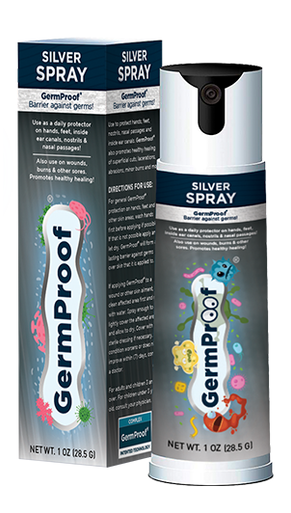
GermProof Chelated Silver Spray

Silver Spray

1 oz pump · hands, feet, surfaces

$14.99

Add to Cart

Details

GermProof Silver Squeeze Gel

Silver Gel

Squeeze tube · rips, blisters, cracked skin

$17.99

Add to Cart

Details

GermProof Spray and Gel combo pack

Spray + Gel Bundle

One of each · best value

$25

Add Both to Cart

Details

▶ Watch the film  ·  Read what customers say

This page is general information plus a summary of an independent laboratory test of our chelated silver. It is not medical advice. GermProof is not a drug and is not intended to diagnose, treat, cure or prevent any disease or infection. Speak to a healthcare professional about any wound or infection.